Key Insights
- Compliance-led safety has delivered enormous gains in Australia, including an 83% reduction in fatal injury rates in WA since the late 1980s, but the improvement curve has flattened.
- The “safety cop” model worked when the problem was recklessness and ignorance. It stalls when the problem is drift inside competent teams.
- The next gains belong to operational leaders who know their critical risks, communicate them in the language of today, and influence consistently, not just during audits or after incidents.
- Compliance is the legal floor. Competence is the destination. You can enforce compliance; competence has to be built.
Workplaces in Australia weren’t always safe. For most of the last two centuries, they weren’t really meant to be. You took the job, you took the risk, and if you came home with all your fingers and your lungs intact, it counted as a good day. The shearers, the wharfies, the crews underground at Mount Kembla and Gretley, the workers and families at Wittenoom. They worked under a deal nobody today would sign. Risk tolerance was higher. People drove without seatbelts, drank at lunch, handled asbestos with bare hands and were told the dust was harmless.
That world is gone, and rightly so. But risk is also what builds a country. We manage it every time we get in a car, sign a mortgage, start a business. Civilisations don’t evolve by eliminating risk. They evolve by getting smarter about it.
How the cop got the badge
Then we grew up. The Robens Report in 1972 reframed safety as a duty rather than a punishment, and the states took the cue. WA passed its Occupational Safety and Health Act in 1984, with others following through the decade. The Model Work Health and Safety Act commenced on 1 January 2012; WA, true to form, was the last to adopt it on 31 March 2022. Standards lifted. Penalties grew teeth. PCBUs, primary duty of care, due diligence, industrial manslaughter: a national vocabulary that didn’t exist a generation earlier.
But a new Act doesn’t change habits overnight, and someone had to police the gap. Enter the Safety Officer. Look at who got the role then, and often still. The person who’d been hurt. The person who’d watched a colleague get hurt. The person who didn’t mind push-back, because they were happy to give it back. Picked not for safety leadership instinct, but because they could enforce. The cop because we needed a cop.
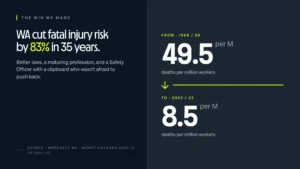
And, credit where it’s owed, it worked. In Western Australia, a worker’s risk of being fatally injured fell 83% between 1988/89 and 2022/23, from 49.5 fatalities per million workers down to 8.5. Better laws, a maturing profession, a shifting view of risk all played their part. The cop, the clipboard and the compliance machine pulled us out of the worst of it.
Where we got stuck
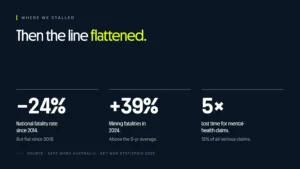
Pull the lens back to the last decade and the picture changes. The national fatality rate has dropped 24% since 2014, from 1.7 per 100,000 workers, but has held steady in recent years. In 2024, 188 workers died from traumatic injuries, against a five-year average of 191.
Mining, the sector that wrote the book on critical risk control, recorded a 39% increase in fatalities in 2024 compared to its five-year average. And the harm is shifting shape: mental health claims now account for 12% of serious claims, with median time lost nearly five times that of other injuries.
The cop has done what the cop can do. Policing always works at the start of a change cycle and stalls at the end.
Compliance gets you to baseline. It catches the lazy and the reckless. What it can’t catch is normalisation of variance inside a competent, well-meaning team: the drift that happens when everyone’s doing what they’ve always done, the procedure no longer matches the work, and the controls live on a SharePoint site instead of in anyone’s head. You don’t audit your way out of that. You lead your way out of it.
What’s actually needed
This isn’t “leadership” as a separate posture, off in its own siloed track. It’s meaningful safety leadership in operations. Leaders who understand the risks they own, who can talk about them in plain language, and who behave the same way at 4pm on a Friday with the schedule slipping as they do in a Monday morning toolbox.

Three things make that real:
- Know your critical risks: Not every hazard. The handful that can kill or seriously maim. If your leaders can’t name them in a lift, and can’t name the controls they’re personally accountable for, you don’t have critical risk management. You have a register. The clearest, kindest thing a safety leader does is name the things that can kill their people, out loud, without flinching.
- Communicate them in the language of today: The workforce you’re leading was raised on TikTok, not toolbox handouts. They scroll, they skim, they learn from short, real, human content. If your safety induction is a 47-slide PowerPoint someone clicks through at 1.75x speed while making a coffee, you don’t have an induction. You have an audit artefact.
- Influence consistently: This is the one that separates leaders from officeholders. Stay curious a little longer than feels comfortable, and the actual hazard, the one no one has logged, usually surfaces. Consistency, not intensity, builds a culture. The team is watching what you do on the bad day, not what you said in the all-hands.
Compliance is the floor. Competence is the ceiling
The goal of all this was never compliance. Compliance is the legal floor. The price of admission. Never the destination. The destination is competence. Competent operations. Competent leaders. Competent teams who understand the risks they’re carrying and can demonstrate, every shift, that they know how to control them. Compliance can be enforced. Competence has to be built.

The Safety Cop got us here. But the role was always a bridge, not a destination. The work in front of us isn’t a job for a cop. It’s a job for operational leaders, safety leaders, who own the risks, communicate them like adults, and behave consistently enough that the team stops needing to be policed.
Frequently asked questions
Compliance sets a baseline. It catches the obvious gaps: missing guarding, expired licences, unsigned permits. But most serious incidents in mature organisations don’t happen because someone broke a rule. They happen because procedures drifted from reality, controls degraded without anyone noticing, or risk was normalised inside a well-meaning team. That’s not a compliance failure. It’s a leadership gap.
References & Sources
- Key Work Health and Safety Statistics Australia 2025, Safe Work Australia, October 2025
- Industry analysis of SWA Key WHS Statistics 2025: mining sector trend, SWA dataset; commentary via Brenniston Safety, November 2025
- WA's worst workplace hazards revealed, WorkSafe Western Australia, May 2024
- Safety and Health at Work: Report of the Committee 1970/72 (the Robens Report), Lord Robens, UK, HMSO, 1972
- Occupational Safety and Health Act 1984 (WA)
- Model Work Health and Safety Act, Safe Work Australia
- Work Health and Safety Act 2020 (WA), commenced 31 March 2022